
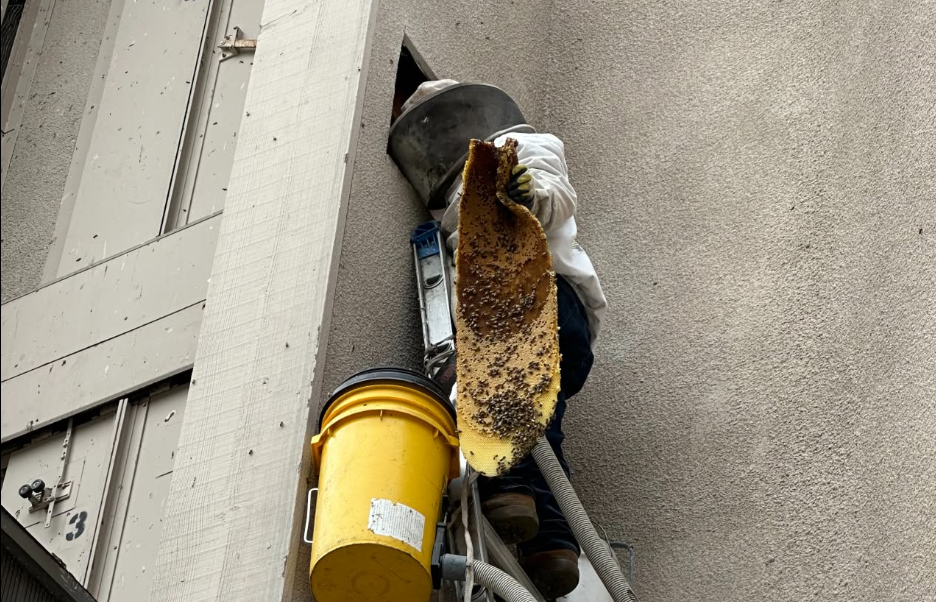
A bee colony on a managed property isn’t just a nuisance call. It’s a liability issue, a tenant relations issue, and depending on the location, a safety issue. Property managers and HOA boards in San Diego deal with bee situations differently than individual homeowners - the stakes are higher, the decision chain is longer, and the window to act is often shorter.
Here’s what you need to know.
Why bee problems escalate faster on managed properties
A homeowner with bees in their wall can monitor the situation and make a decision on their own timeline. A property manager gets a call from a tenant, then another, then a complaint through the HOA portal, then a question about liability. By the time the removal is scheduled, the colony has been there for weeks and the job is more involved than it would have been if caught early.
The other factor is density. In apartment complexes, condos, and HOA communities, a colony in one unit’s wall is often adjacent to another unit. What starts as one tenant’s problem becomes a building-wide issue quickly.
What liability looks like for managed properties
If a tenant or visitor is stung on a property where management knew about an active bee colony and failed to act, that’s a documented negligence exposure. The standard isn’t perfection - it’s reasonable response time and appropriate action. Calling a licensed removal specialist promptly and documenting the job protects the property and the management company.
San Diego County has established Africanized honey bee populations. Any colony on a managed property should be treated as potentially Africanized until proven otherwise. This isn’t alarmist - it’s the standard of care that protects everyone involved.
What MJC provides for commercial and HOA clients
MJC Live Bee Removal has been serving San Diego County since 2014. For property managers and HOA boards, the job looks like this:
Same-day service is available for active colonies near entryways, HVAC systems, or high-traffic areas. The removal team accesses the colony, extracts the bees alive, pulls every piece of honeycomb, applies the Pheromone Neutralization Protocol™ to eliminate the scent trail that attracts future swarms, and seals the entry point. The job is documented so property managers have a record of what was found, what was done, and what was repaired.
No subcontractors. The same family team - Mario, Johnny, and Charly - handles every job. That matters for managed properties where accountability and follow-through are non-negotiable.
Common locations on managed properties
Wall voids between units are the most common. Bees enter through a gap on the exterior of one unit and build comb that spans into adjacent wall cavities. Eave spaces above carports and covered walkways are also frequent. Roofline penetrations around HVAC equipment, utility runs, and roof vents are entry points that often go unnoticed until a colony is well established.
Irrigation controller boxes, electrical panels, and underground meter housings occasionally harbor yellow jacket nests - a separate issue from honey bees but one that also requires prompt response on managed properties.
The right response protocol
When a tenant reports bees, the fastest path to resolution is a photo and a call. A photo of the entry point or the swarm tells a specialist immediately what they’re dealing with - whether it’s an established colony, a temporary swarm, or something other than honey bees entirely. From there, same-day response is available across San Diego County.