
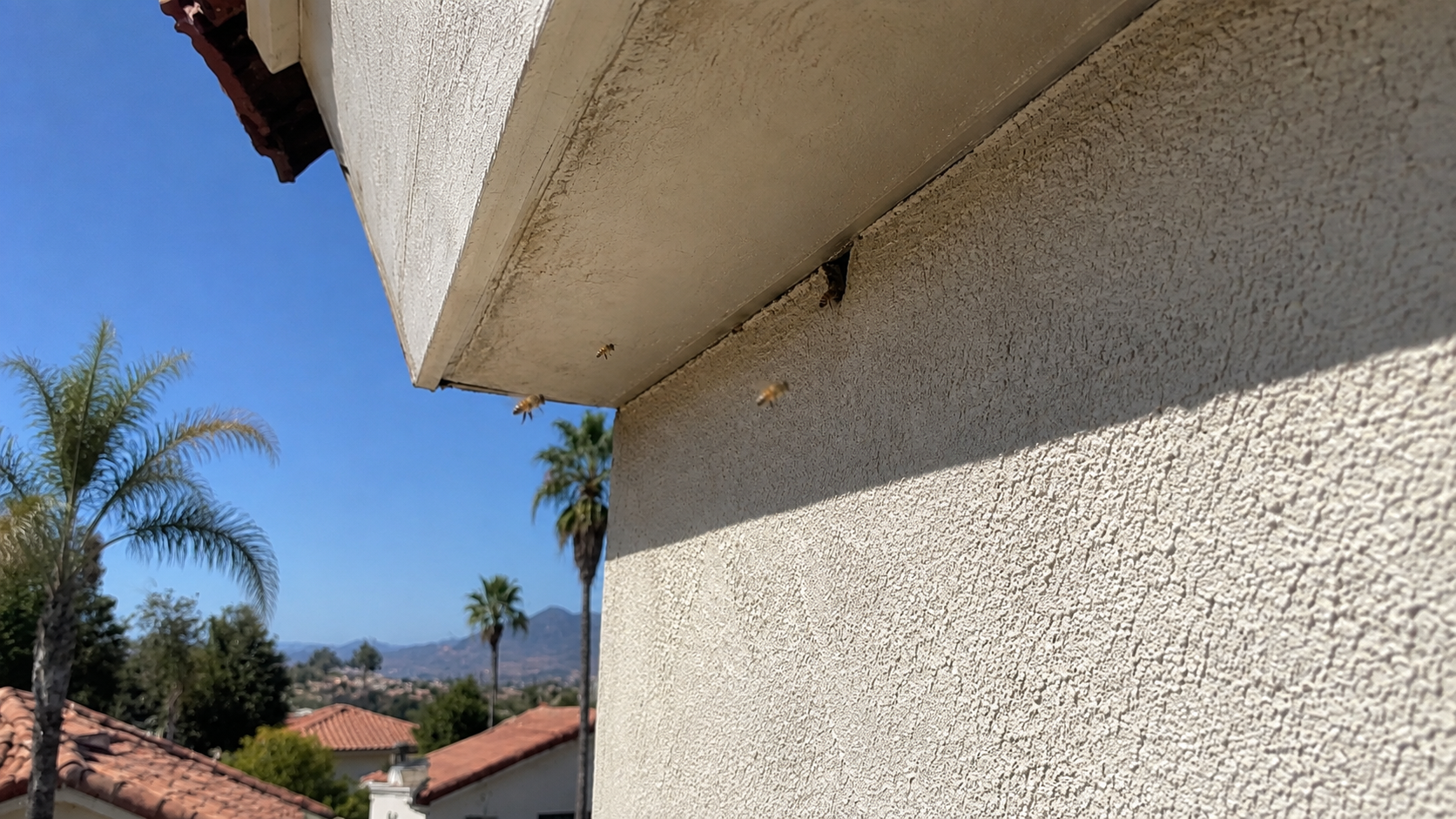
Bees Entering a Hole in Your Wall? Here’s What It Usually Means
A few bees flying around your home may not seem serious. But if they repeatedly enter and leave the same hole in your stucco, siding, eaves, or roofline, they may be using an enclosed space inside the structure.
That does not automatically tell you how large the colony is or how long it has been there. It does mean the activity deserves a closer look.
Key Takeaways
Bees repeatedly using the same opening may be scouting the space or living inside it.
Regular traffic in and out of the opening is more concerning than a few bees briefly hovering nearby.
Do not seal the hole while bees are actively using it.
Spraying the entrance may affect visible bees without removing a colony or honeycomb hidden inside.
A professional inspection can determine whether you are seeing scouts, a temporary swarm, or an established colony.
Why Bees Choose Wall Cavities
Honey bees naturally look for protected spaces where they can build comb and raise brood. In San Diego homes, suitable spaces may exist behind stucco, inside framed walls, beneath roof tiles, around chimneys, or behind fascia boards.
Common entry points include:
Cracks or gaps in stucco
Openings around pipes and utility lines
Damaged vents or screens
Gaps beneath roof tiles
Openings along eaves and fascia
Small spaces around exterior trim
Unsealed construction joints
The visible opening can be small even when the space behind it is much larger.
Are They Scout Bees or an Established Colony?
Scout bees inspect possible nesting locations before a swarm moves in. You might see a small number of bees hovering around an opening, entering briefly, and then leaving.
Scout activity can be irregular. It may appear for a few hours and then stop.
An established colony usually produces more consistent traffic. Bees leave to collect pollen, nectar, and water, then return through the same entrance. Activity may increase during warmer and brighter parts of the day.
Signs that bees may already be living inside include:
Bees using the same opening throughout the day
Regular incoming and outgoing traffic
Bees carrying visible pollen on their hind legs
Buzzing from inside the wall
Activity continuing for several days
Honey staining or residue appearing indoors
Bees unexpectedly entering rooms through lights, vents, or small interior gaps
These signs cannot tell you the colony’s exact size. A professional inspection may be needed to locate the colony and determine the appropriate removal plan.
Should You Seal the Hole?
Do not seal an entrance while bees are actively using it.
If a colony is already inside, sealing the exterior opening can trap bees and force them to search for another exit. That may send them deeper into the structure or, in some situations, into the living area.
Sealing is an important part of preventing future access, but it should happen at the proper stage of the removal process.
The colony and accessible honeycomb should be addressed first. The cavity can then be cleaned and treated, and accessible entry points can be sealed.
Why Spraying the Entrance May Not Solve the Problem
The bees visible outside may represent only a portion of what is inside the structure. Spraying an entrance does not necessarily reach the queen, brood, stored honey, wax, or comb inside the wall.
If comb and hive residue remain, they can create additional problems. Depending on the location and condition of the hive, remaining material may:
Leak or stain drywall and other finishes
Attract ants or other pests
Produce odors
Leave the cavity suitable for future bee activity
Require structural cleanup later
The University of California’s Integrated Pest Management program explains that removing an established colony from a building generally involves opening the structure, removing the bees and comb, closing the opening, and addressing possible entrances. That is different from treating only the bees visible outside.
What Professional Wall Removal Involves
A structural bee-removal project should begin by identifying where the bees are entering and where the colony is located.
Depending on the property and hive location, the process may include:
Inspecting the exterior activity and entry point
Locating the colony inside the wall or adjacent cavity
Creating controlled access to the affected space
Relocating the colony when conditions allow
Removing accessible honeycomb and hive residue
Cleaning and treating the cavity
Sealing accessible entry points
Completing repairs that fall within the company’s scope
Not every wall or hive is identical. Stucco, siding, drywall, block walls, chimneys, and rooflines may require different access and repair plans.
Will the Bees Leave on Their Own?
A temporary swarm resting in the open may move to another location. An established colony living inside a wall is different.
Once bees have begun building comb and raising brood inside a protected cavity, waiting is unlikely to resolve the underlying issue. The colony may continue using and expanding within the available space.
The earlier the situation is inspected, the easier it is to understand what is happening before more comb is built.
What to Do While You Wait for an Inspection
Until the activity can be evaluated:
Keep children and pets away from the entrance.
Do not bang on the wall or disturb the area.
Avoid mowing, trimming, drilling, or using loud equipment immediately beside the opening.
Do not place a ladder against the area to inspect it yourself.
Take a photo or short video from a safe distance.
Note when you first noticed the activity and whether it is increasing.
Tell the removal company if anyone has been stung or the colony appears unusually defensive.
Africanized honey bees are established throughout San Diego County and cannot be reliably distinguished from European honey bees by appearance alone. The safest approach is to avoid disturbing any unknown colony.
Bee Removal and Wall Repair in San Diego
MJC Live Bee Removal handles bees living inside walls, stucco, rooflines, attics, chimneys, and other structural spaces throughout San Diego County.
When conditions allow, the colony is relocated. MJC also removes accessible honeycomb and residue, cleans and treats the cavity, seals accessible entry points, and completes repairs that fall within its scope.
Learn more about bee removal from walls or bee damage repair.
Frequently Asked Questions
Does one bee entering a wall mean there is a hive?
Not necessarily. A single bee may be exploring or may have entered accidentally. Repeated activity at the same opening, especially consistent incoming and outgoing traffic, is a stronger sign that bees are scouting the cavity or living inside it.
How long does it take bees to build a hive inside a wall?
There is no single timeline. Colony development depends on the season, available space, food sources, weather, and the strength of the colony. If activity continues for several days, an inspection is more reliable than trying to estimate the hive’s age from outside.
Can I close the hole at night when the bees are inside?
No. Sealing an active colony inside the wall can cause bees to search for another exit and may force them farther into the structure. Removal and cleanup should occur before the entrance is sealed.
Will spraying the opening remove the hive?
Spraying the entrance may affect some visible bees, but it may not remove the colony, queen, brood, honeycomb, or stored honey inside the wall. A complete structural removal addresses both the bees and the material inside the cavity.
Can MJC repair the wall after removing the bees?
For many structural removals, MJC can close and repair the access opening as part of the project when the repair falls within its scope. More extensive damage may require a separate repair plan, which can be discussed after inspection.
Seeing Bees Enter the Same Hole?
Do not seal the entrance or disturb the area. Call MJC Live Bee Removal at (619) 550-0687 to ask about an inspection and current service availability.
MJC serves homeowners and businesses throughout San Diego County.