
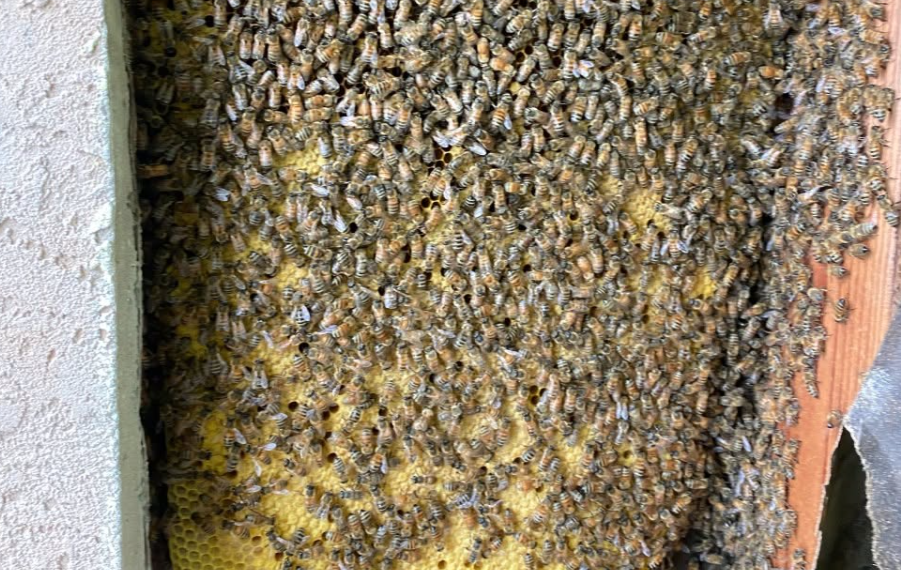
When people discover bees in their wall, the instinct is often to wait. The colony seems small, the buzzing seems manageable, and removal feels like something to deal with later. The growth rate is the part that catches most homeowners off guard.
How a colony starts
A colony doesn’t move in all at once. It starts with a swarm - a reproductive split from an existing colony. The old queen leaves with roughly half the worker bees, anywhere from 5,000 to 20,000 bees depending on the size of the parent colony. They rest temporarily as a cluster while scouts search for a new home.
Once scouts agree on a location - a wall void, an attic space, a tree hollow - the swarm moves in and starts building immediately. From that first day, the clock is running.
Growth in the first season
A swarm that establishes in spring starts small but scales fast. The queen can lay up to 2,000 eggs per day. Worker bees live for about six weeks during active season, but they’re constantly being replaced. By midsummer, a colony that moved in with 5,000 bees can reach 40,000 to 60,000.
The comb grows with the colony. Bees need wax comb for brood rearing, honey storage, and pollen storage. A mature summer colony can fill a significant wall void - in some cases 40 to 60 pounds of honeycomb packed into a space between wall studs.
What size means for removal
A small swarm caught in the first few weeks is a straightforward job. The comb is limited, the wall access is minimal, and extraction takes a few hours.
A mature summer colony is a different job. More bees means more defensive behavior during removal. More comb means more wall access to reach and extract it all. Partial comb removal - leaving honeycomb behind - is not acceptable. Unextracted comb melts in San Diego’s summer heat, honey seeps into drywall, and the structural damage compounds over time.
The difference in job complexity - and cost - between a small early-season swarm and a large midsummer colony is significant. Early removal is almost always the simpler, less expensive option.
What happens in year two
Colonies that survive their first winter emerge in spring at a larger size than they started. They’ve been building through fall and maintaining through winter. When spring arrives and the colony reaches maximum size, it swarms - sending scouts out to find additional nesting sites. In San Diego’s mild climate, this cycle runs reliably year after year.
A colony in your wall that goes untreated through one winter is larger, more established, and more expensive to remove the following spring than it was when it first moved in.
Africanized colonies in San Diego
San Diego County has established Africanized honey bee populations. Africanized colonies are generally smaller than European honey bee colonies - they establish in tighter spaces and swarm more frequently. But they are significantly more defensive, particularly as the colony grows and the nest becomes established. A large Africanized colony in a wall void that is disturbed incorrectly can be genuinely dangerous.
You cannot identify an Africanized bee by appearance alone. Any established colony in San Diego should be approached with that in mind.