
Swarm season in San Diego runs March through June. That’s the window when colonies split and scout bees go looking for new nesting sites. The month before that window is the best time to walk your property and close the gaps scouts are looking for.
This isn’t complicated work. Most of what bees use to get into a home is already visible on the surface.
What scouts are looking for
Scout bees aren’t flying randomly. They’re evaluating specific criteria - cavity size, protection from weather, orientation, proximity to foraging. What they need from the exterior of your home is a way in. A gap of 3/8 of an inch is enough. They’ll inspect dozens of potential sites before the swarm commits.
The good news is that most entry points are the same across San Diego homes. Once you know where to look, a walkthrough takes under an hour.
The walkthrough
Eave ends. Open eave ends are the most common bee entry point on San Diego homes. Walk the roofline and look for eaves that aren’t fully enclosed. If you can see into the rafter space from the ground, scouts can find it too. Aluminum or vinyl soffit covers close these openings cleanly.
Stucco cracks. Stucco expands and contracts with temperature. Older homes develop hairline cracks that widen over time, particularly around window frames, where two stucco planes meet, and at the base of walls. Any crack wide enough to catch a fingernail is wide enough to check.
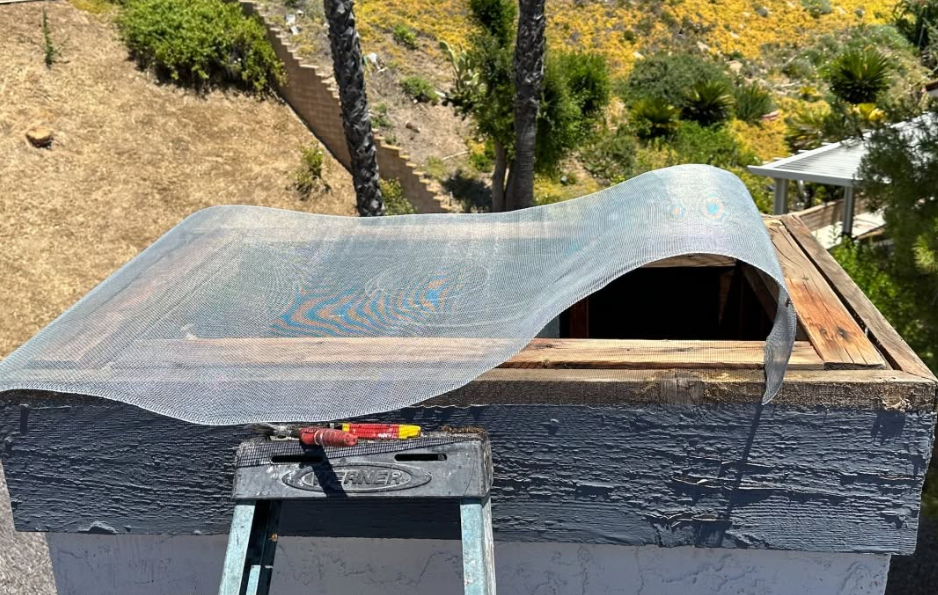
Roof vents and exhaust caps. Standard roof vents and exhaust caps often have gaps around their edges or deteriorated screening. Check the screening on all attic vents and replace any that are torn, rusted, or missing.
Utility penetrations. Every pipe, conduit, and cable that enters your home from the exterior leaves a potential gap around it. Foam backer rod and exterior-grade caulk close these quickly. Check water lines, gas lines, electrical conduit, cable and internet lines, and AC refrigerant lines.
Irrigation controller boxes. These are often overlooked. The interior of an irrigation controller box is a dark, protected cavity - exactly what scouts look for. Check that the box closes tightly and that there are no gaps around the conduit entries.
Crawl space vents. Ground-level crawl space vents are common nesting sites. Check that all screens are intact and that the vent covers are fully seated.
What to use
Exterior-grade caulk works for small gaps around penetrations and stucco cracks. Hardware cloth - 1/4 inch mesh - covers larger openings like broken vent screens. Aluminum soffit panels close open eave ends. All of these are available at any hardware store and most can be installed without tools beyond a caulk gun and tin snips.
If you find an opening but aren’t sure whether bees have already moved in - bees going in and out of the same gap is the tell - don’t seal it yet. Call a removal specialist first. Sealing an entry point with an active colony inside forces bees to find another exit, sometimes through interior walls.
One walkthrough, one time
Bee-proofing your home once, done properly, reduces the risk significantly for years. Most entry points don’t reopen unless something physically damages the repair. The hour it takes to walk the perimeter before March is almost always less expensive than the alternative.