
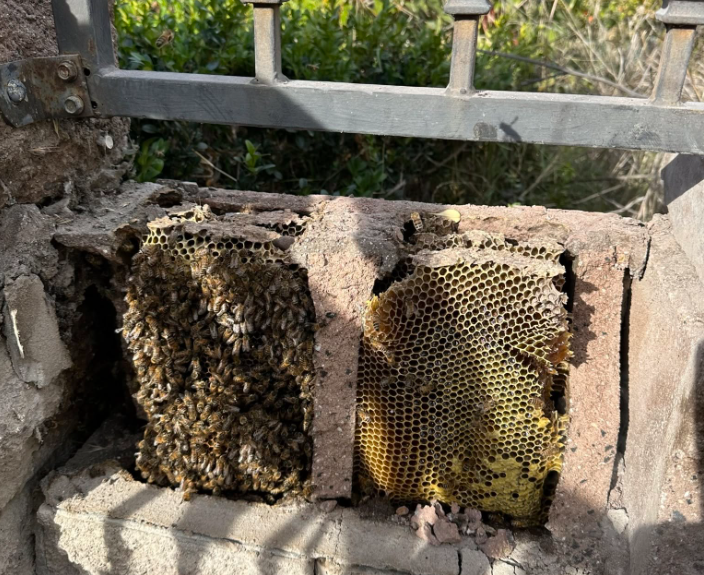
A colony that moves into your wall doesn’t knock first. Most homeowners don’t realize bees have established inside a structure until the colony has been there for weeks - sometimes months. By that point, the comb is built, the colony is growing, and the removal job is significantly more involved than it would have been caught early.
Here’s what to actually look for.
The sound comes first
The earliest sign most people notice is a low hum from inside a wall - usually in the afternoon when the colony is most active. It’s easy to dismiss as an appliance, pipes, or outside traffic. The difference is that it’s localized to one spot and it’s rhythmic. If you press your ear to a wall and hear a consistent buzz that doesn’t match any mechanical source in your home, there’s a good chance bees are inside.
A consistent entry point
Honey bees don’t use random gaps to come and go. Scout bees choose one entry point and the colony uses it consistently. If you see bees entering and exiting the same small opening - a gap in stucco, an open eave end, a crack near a window frame, a hole around a utility line - that’s a strong indicator of an established colony, not just bees flying past.
Watch the entry point at different times of day. Morning and late afternoon tend to show the most traffic. A consistent stream of bees going in and coming out of the same spot is the clearest sign you have a colony inside.
Visible wax or propolis
In some cases, especially around older stucco homes, you’ll see dark staining or a waxy buildup around the entry point. Bees use propolis - a resinous substance - to seal gaps and regulate the entrance size. If you see a dark, waxy residue around a small hole, bees have been using it long enough to modify it.
Bees inside the house
If bees are appearing inside your home - coming out of a light fixture, an outlet, or a gap in the ceiling - there’s almost certainly a colony in the wall or attic nearby. Bees don’t enter living spaces by choice. When you see them indoors, it usually means the colony has expanded enough that some bees are finding their way through gaps in the interior wall.
Soft spots or staining on walls or ceilings
A mature colony can hold 40 to 60 pounds of honeycomb. In San Diego’s summer heat, the wax softens and honey can liquefy and start moving through wall insulation and drywall. If you notice a soft spot, a yellowish stain, or a sweet smell coming from a wall or ceiling with no other explanation - it may be honey. This is a sign of a large, established colony and it means the removal job will involve structural repair as well.
What to do when you notice these signs
Don’t seal the entry point. Don’t spray into the gap. Take a photo if you can do it safely from a distance, note the location, and call a removal specialist. The earlier the colony is caught, the simpler and less expensive the removal.